

After years of waiting for the Grand Egyptian Museum to open, I finally got to step inside last month. This happened during my visit to Cairo. As a dedicated museum professional, I will share my unique perspective on my visit. This will offer a fresh take on this newly opened institution. I will focus on the overall experience, museum layout, nation on display, effectiveness of display and accessibility.
OVERALL EXPERIENCE and MUSEUM LAYOUT
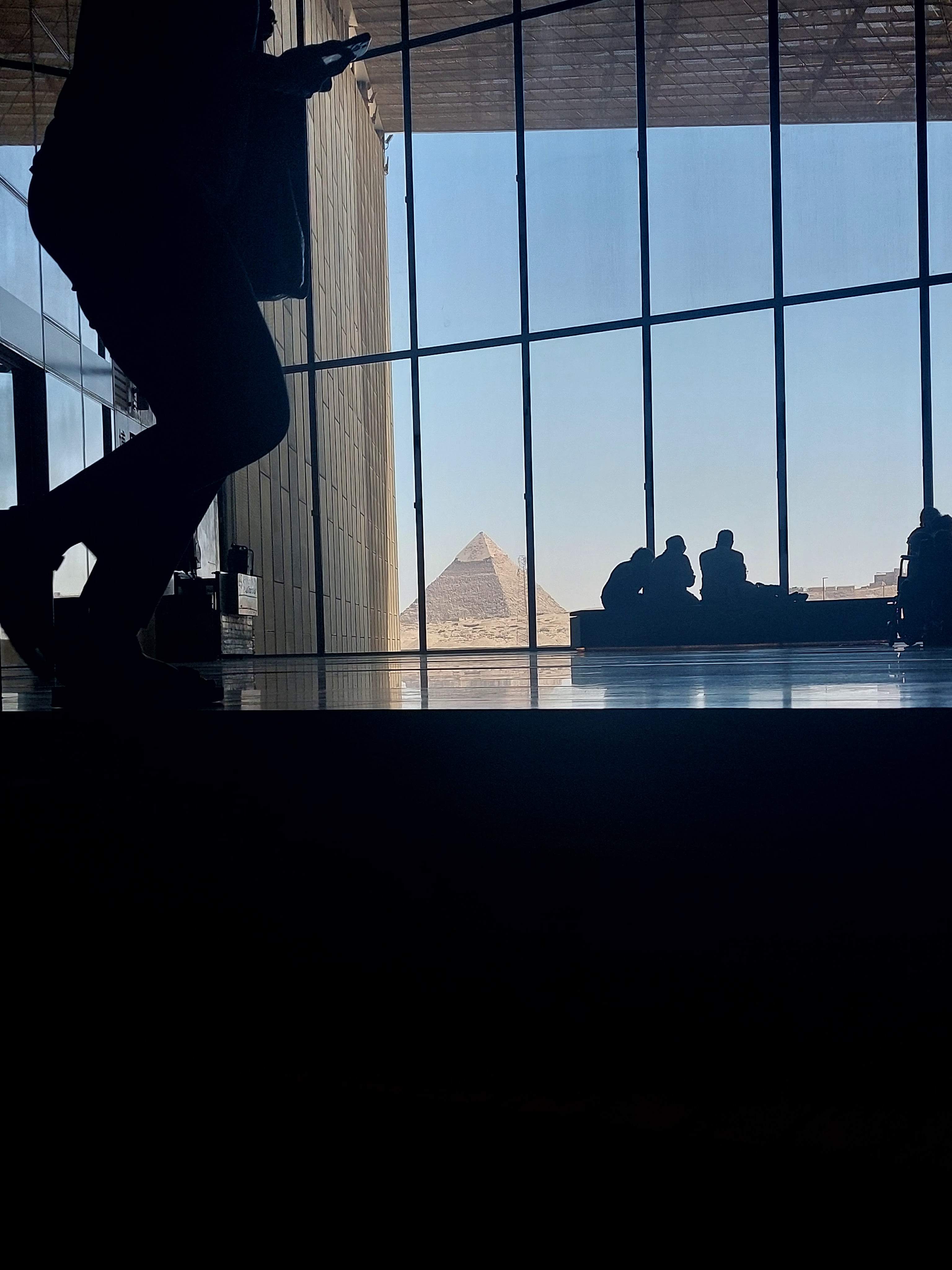
The landscape created an awe-inspiring atmosphere as we drove to the museum parking lot. The Giza pyramid complex was behind the Grand Egyptian Museum. I see two of the three pyramids from the road. In the other direction, I walked up to the payment counters, which were fast and not too busy. At this time in the hot summer, only about 20 people were waiting in the lines.

We were informed that only one gallery area was open now due to the other galleries still in progress, which I did not mind. For a first visit, it is important not to feel overwhelmed or fatigued. In contrast, visiting museums with multiple galleries makes visitors rush to see it all, and museum fatigue sets in.
The museum building is truly a marvel. Its sheer size and grandeur left me in awe as I approached the entrance. I couldn’t help but think this building could be equated to a modern pyramid. The need for a lot of space should not be surprising, as anyone with access to the news will see how often cultural belongings/artifacts are unearthed in Egypt and how many repatriations happen yearly. [As a side note, I am very interested in how many cultural belongings/artifacts have been repatriated from other museums and private collections back in Egypt.]
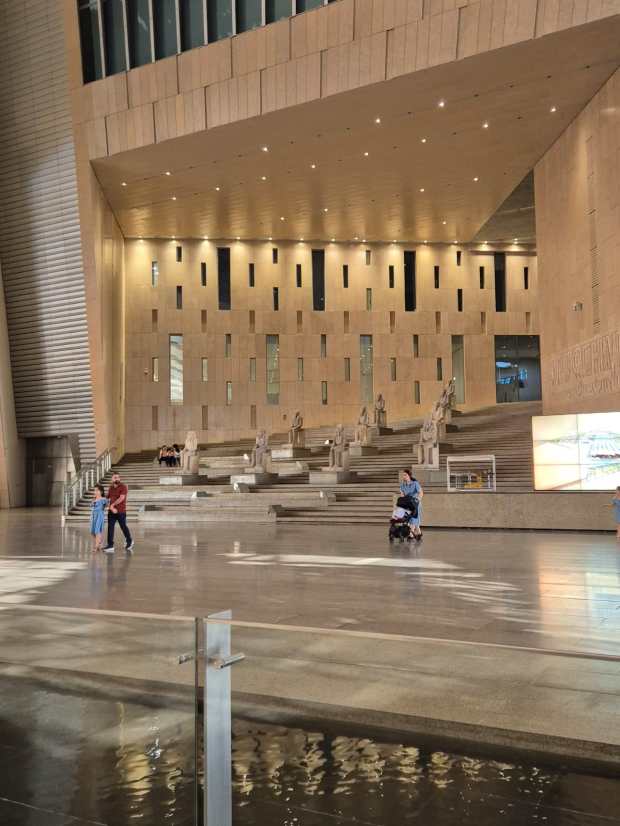
Inside, the natural and artificial lighting created more awe, as now there is an 11-meter-tall statue of Ramesses II surrounded by water. The main hall has high ceilings, shops, cafes, and restaurants on one side and small statues on stairs leading to the open gallery. From the entrance, I can’t see how high those stairs go on the left-hand side from the entrance. It is very peaceful inside, and I wonder if it is because everyone’s jaw has dropped. I imagine that in the future, this hall will be packed with tourists when it is fully open.

An optional tour guide included in the ticket price is a fantastic perk! In my experience of visiting museums worldwide, this is a rare option. Still, I choose to wander around alone as I like to read all the displays and walk around slowly. Next time, I will ask for a museum guide.
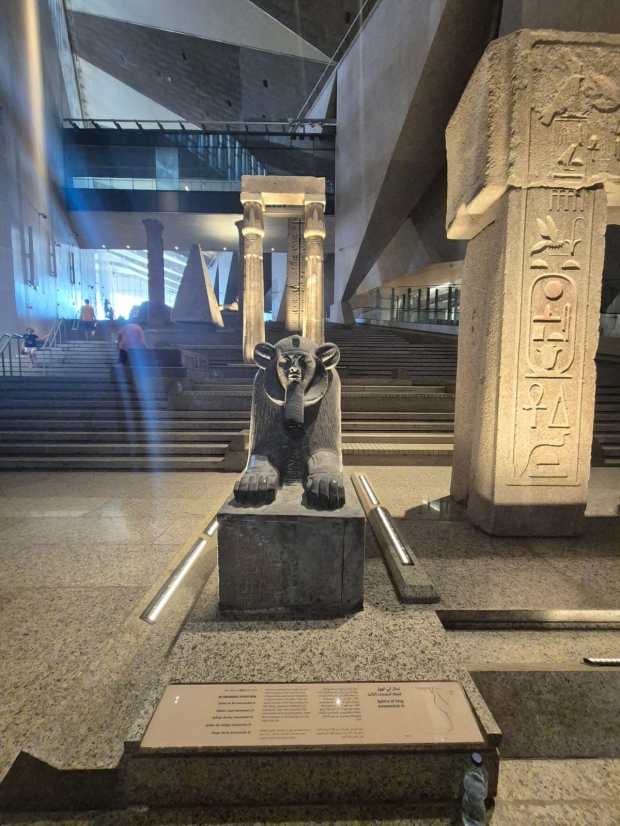
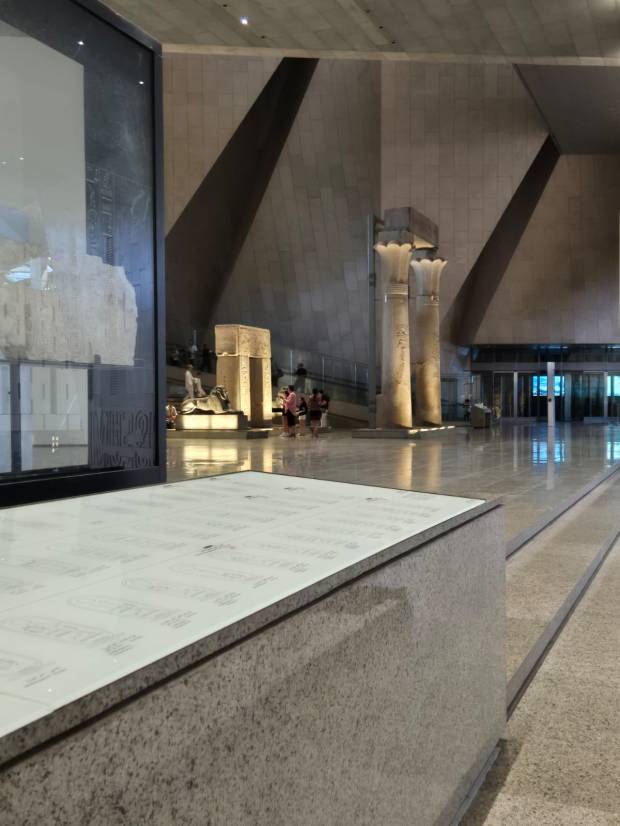
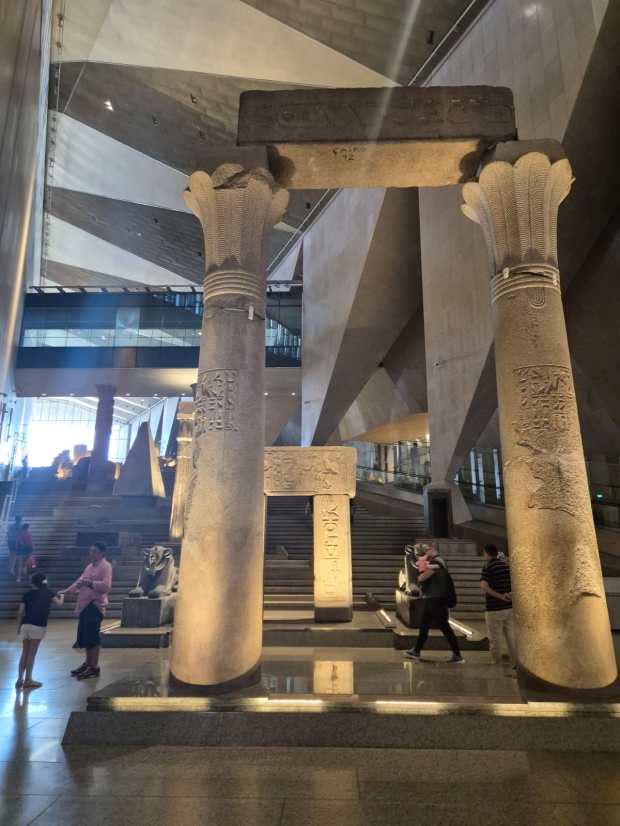
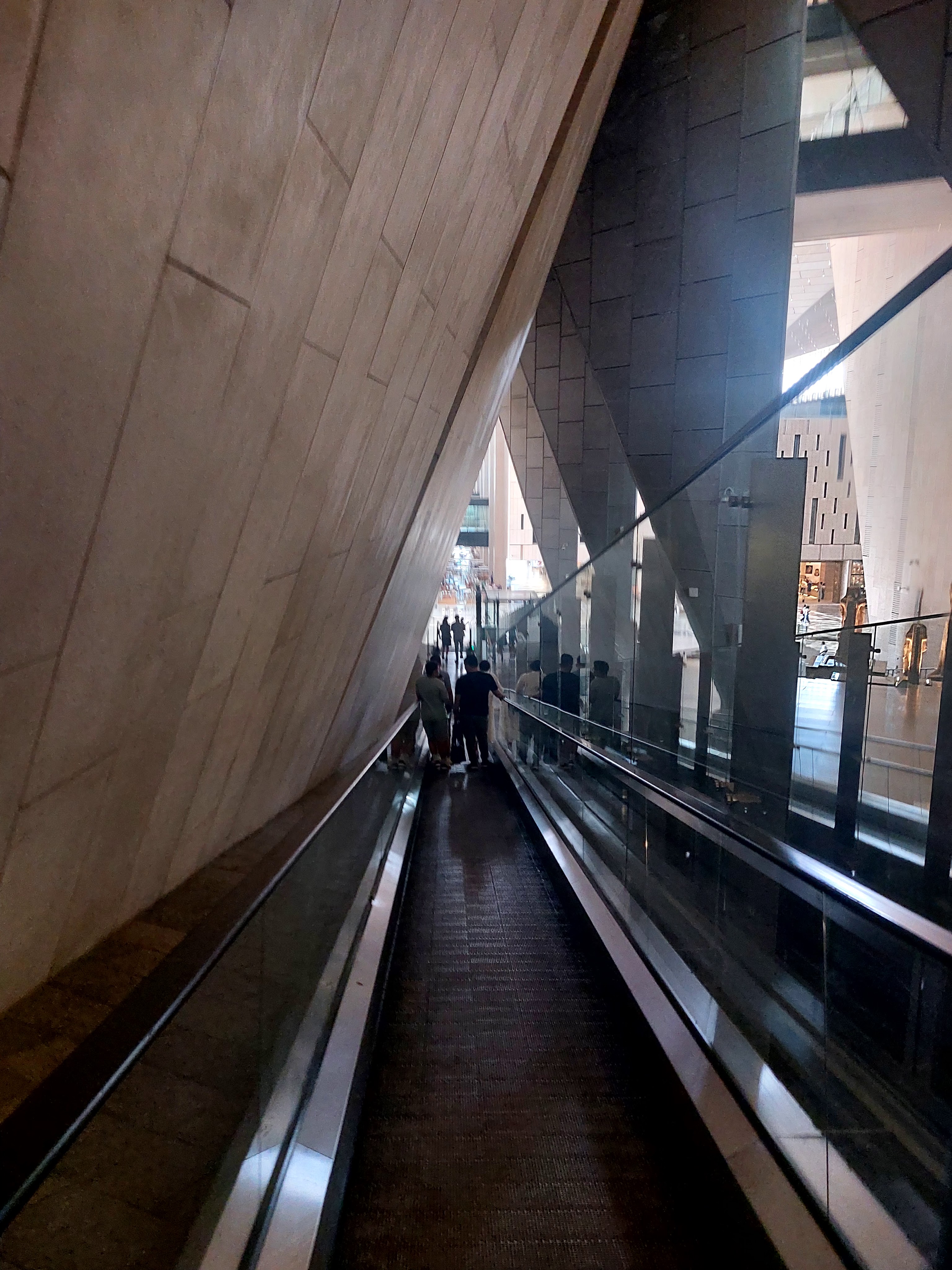
On the left-hand side of the entrance hall, there are several display areas, two for statues and a dynasty hieroglyphic display. The display of different kinds of statues goes up the stairs, and at the top, there is an astonishing view of the pyramids. It makes the trek even more worth it, but don’t worry; you can take the travelator if you’d prefer. The selected statues had a variety of stone types and styles. These were often highlighted by the connections with others in the world. They were also highlighted by beliefs held by the ancient Egyptians.

In my experience visiting museums around the world, I have noticed something. There is rarely a decent coffee shop or restaurant available. If there is one, it is usually severely overpriced for very mediocre food/coffee. The visitor wants a break after hours of walking and enjoying the museum. The local restaurants and cafes are excellent, and the food and coffee are amazing. This is all part of the museum experience, and the Grand Egyptian Museum created excellent planning for this.

THE NATION ON DISPLAY
The Grand Egyptian Museum is a national historical museum. These national historical museums are essential places within their country to share their history. Due to the structure and display of this museum in one of the most highly touristed places in the world, I would expect that the main visitors would be tourists. The museum is in one of the most touristed places in the world. Because of this, I would expect the main visitors to be tourists. At the time of my visit, I would guess most of the people there at the time as me were tourists. But, I imagine this institution would be used for educational programming with local schools.
ACCESSIBILITY
Upon visiting a large grand museum, one should expect considerable walking, and this museum is no different. From the parking lot to the top of the opened gallery with many stairs to see all the cultural belonging/artifacts laid out on display, though, a travelator can reach the top of this up-hill gallery room and make stops along the way. I think this was an excellent addition to increase accessibility, but it will not allow access to all parts of this gallery for those who not be able to go up the steps between the travelator stops.
All the statues in the hall have labels in several languages, with more significant texts in English and Arabic. I enjoyed the addition of the map on the labels to show where the cultural belonging/artifact was found. Everything was straightforward to read. The path for the display is not self-guided but instead follows a sequence.
Midway through the exhibit, there is a 3D-printed statue touching station with braille for the seeing impaired. Incorporating a 3D-printed cultural belongings station into the exhibit gives the visitor another learning experience through touch (tactile). I believe that all visitors can benefit from these learning materials. It can also give our younger visitors a break, as most have been trying to control themselves by not touching all the cultural belongings they have seen thus far!

I noticed a children’s area that seemed to be in the stages of development. I am so happy to see the effort to engage younger visitors; however, in my experience, those activity rooms are enjoyable for everyone. Incorporating play makes learning more fun and can make the experience enjoyable for all kinds of visitors.
SUMMARY
This national historical museum has dramatic settings, atmospheres, and landscapes that will amaze you. It has not fully opened, but from what I can see, it seems to have a traditional guided structure.
Since the museum has not fully opened, I must return for the whole experience. In the meantime, I have given a commentary on the ambiance, accessibility, and effectiveness of the display.
Here are my highlights:
- The museum ambiance
- The construction of a new reality through the location, architecture, lighting, and cultural belongings/artifacts
- 3D-printed tactile station
- The maps next to the exhibit text that show where the cultural belonging/artifact was found
- Finding out that the cafes and restaurants were terrific (30 North and Zooba).


 Culture Talks